
Local Elections: How parties pledge to tackle libraries, school safety and ECD
By Mandisa Makgakga
2 November 2026 · 4 min read
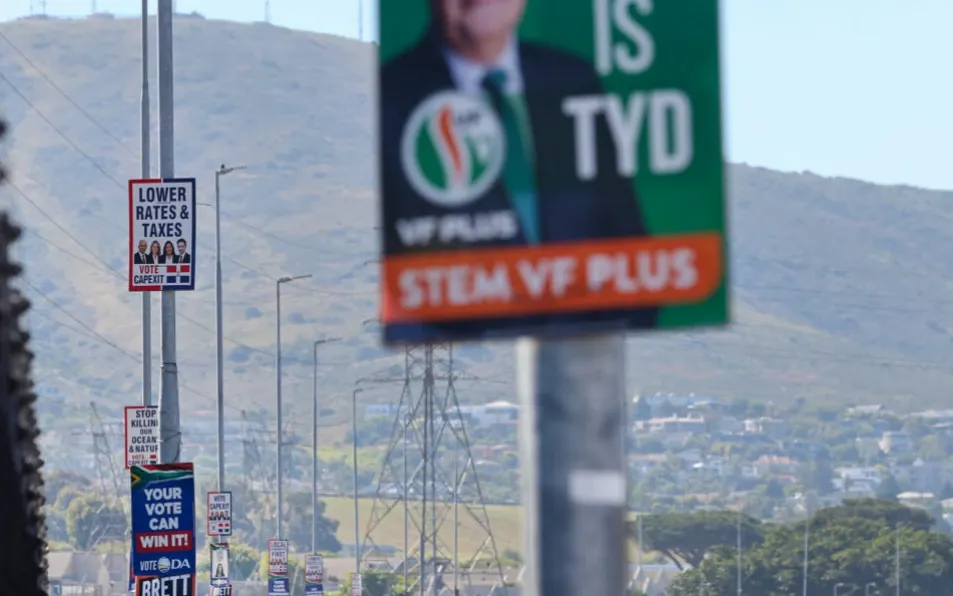
THE PARTY LINE-UP: Election posters along Plattekloof Road, Cape Town, ahead of elections. 27 October 2026. Photo: Shelley Christians/EdDesk
Ahead of Local government elections, EdDesk reviewed 12 party pledges on three core learning-related issues, bearing in mind that schooling is a provincial and national responsibility.
Political parties will battle it out for votes in November 4 local government elections, promising to strengthen municipal support for an overburdened education system.
Pledges include safer routes to school, support for early childhood development (ECD) centres, restoring neglected libraries and turning underused buildings into creative hubs.
Pledges include safer routes to school, support for early childhood development (ECD) centres, restoring neglected libraries and turning underused buildings into creative hubs.
EdDesk reviewed the 2026 election manifestos of 12 established and emerging parties, focusing on their pledges for libraries, early childhood development (ECD) and school-specific safety.
They are among the 546 parties contesting elections, according to the Electoral Commission. Voters will elect councillors who can influence roads, infrastructure, community safety, library services and ECD centre registration. Schooling falls outside the mandate of local authorities as it is a national and provincial responsibility.
Libraries featured most frequently, with explicit pledges identified for 10 parties. Five made specific ECD commitments, while seven identified measures directly linked to school safety. Broader general-service promises that might indirectly help children or schools were excluded from the tally, as were regional and ward-level candidate manifestos.
ActionSA plans to reform ECD and public education by cutting municipal red tape and boosting policing to counter infrastructure neglect. The party wants to expand ECD funding, introduce nutrition schemes and train informal operators excluded from state support. It also proposes public-private agreements to turn abandoned or seized municipal buildings into compliant spaces for community crèches. “Buildings ought to be for creating a better life. Reclaiming hijacked and abandoned buildings and handing them to the private sector would enable this, thereby improving the lives of our people,” party leader Herman Mashaba said.
Also ticking all three boxes, the SACP proposes connecting local food production directly to school nutrition programmes to safeguard children. It advocates for ward safety audits, safer routes to school, and targeted law enforcement action against drug dens and illegal outlets operating near schools. On libraries, the party proposes developing them as community knowledge and cultural centres equipped with internet access and study space.
The ANC promises to make every municipal library accessible, well lit, equipped with public Wi-Fi and able to offer programmes. It also pledges to improve the maintenance and accessibility of community facilities, including halls and sports grounds, within five years. The party acknowledges that neglect has left some facilities vandalised or unused. The ANC also plans to establish Community Safety Forums in every municipality, and proposes expanding public facilities to accommodate ECD services.
The Democratic Alliance (DA) pledged to improve libraries through partnerships with private organisations and make school routes safer. Its main manifesto does not include ECDs, though in uMngeni in KZN, it proposes supporting home-based crèches through its Day Mothers Programme. On school safety, the DA proposes a Safe Routes to School programme, including paved walkways, improved street lighting, and dedicated learner transport in high-crime areas. It also calls for school resource officers at schools affected by gang violence and a National School Protection Response Team to tackle vandalism and crime.
The Economic Freedom Fighters (EFF) has committed to building more schools, replacing pit-and-bucket toilets with flushing sanitation, establishing libraries in under-resourced schools, and expanding free public Wi-Fi to promote reading. “EFF municipalities will build, maintain, and upgrade sports facilities, libraries, parks, recreational centres, stadiums, and other community facilities, with a particular focus on townships, informal settlements, and rural communities,” said party leader Julius Malema.
The United Democratic Movement (UDM) promises to upgrade libraries and public spaces and provide internet access for job seekers and learners. It also proposes better spatial planning to support ECD centres. Party leader Bantu Holomisa called for a nationwide review of school safety measures, including supervision audits and infrastructure upgrades. At municipal level, the UDM promises stricter by-law enforcement and community policing partnerships to improve school safety.
Build One South Africa has pledged to turn municipal libraries into digital hubs where young people can access technology and develop skills. It also plans to strengthen metro policing to tackle drugs and crime around schools. Its broader plans for school security, staff vetting and infrastructure improvements depend on its national government.
The African Christian Democratic Party (ACDP) issued mandates for the eradication of school pit latrines in favour of flushing sewer systems. It pledged to build, upgrade, and maintain community libraries. The party commits to improving community safety.
The Inkatha Freedom Party (IFP) pledged municipal funding to expand ECD centres and support school nutrition programmes. It also promises to upgrade libraries and provide free community Wi-Fi for young job seekers. For learner safety, the party proposes 24-hour traffic policing near schools, stricter rules for scholar transport, and municipal support desks offering social work services. “The IFP will continue to build and expand sports complexes, sports fields and community facilities, including community halls and early-childhood-development centres,” the party said.
The MK Party commits to repairing and maintaining libraries, establishing ECDs in underutilised buildings, and for new housing developments to demonstrate accessibility to schools.
Tracking the Patriotic Alliance (PA) was inconclusive, as no complete written 2026 manifesto could be located. Its launch manifesto in Bloemfontein on 26 September 2026 covered by-law enforcement, undocumented migration, title deeds and municipal rates.
Note: As Schooling is not a local government responsibility, this review is not an exhaustive assessment of education policy. It covers three targeted, identified areas. EdDesk examined available 2026 municipal manifestos, municipal plans and launch statements. AI-assisted search and comparison tools helped with sourcing and searching.

You may also like

Land Row Rocks Sleepy Seaside Village Of Hamburg
Asemahle Mfombi · 3d ago · 5 min read

Kariega-based CEO Scoops Prestigious National Business Award
Thobile Hans · 4d ago · 4 min read
Kwankwa Goes Home To Seek Royal Blessings Ahead Of The Elections
Viwe Dyantyi and Avuyile Hlangwana · 26 Oct · 1 min read