
Hello, World! IYunivesiti Walter Sisulu Joins Nelson Mandela University In Global Rankings
By ZOLILE MENZELWA AND LULEKWA MTHALALA
6 October 2026 · 3 min read
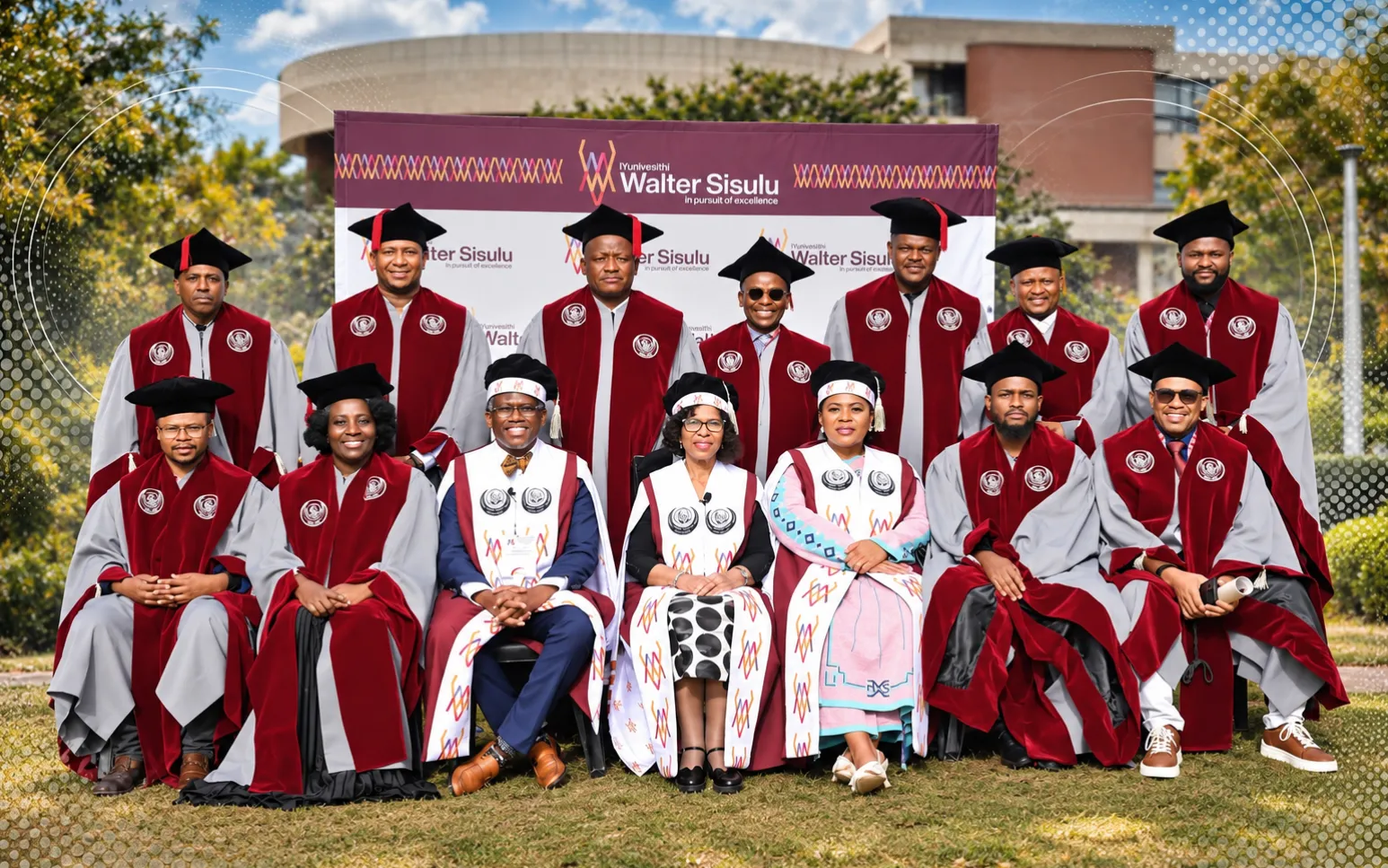
Vice Chancellor, Dr Thandiswa Mgwebi with members of the council and senior executive team
The Mthatha-headquartered university is this week celebrating its historic first appearance in the global rankings, while Nelson Mandela University again flies the province’s flag among the world’s leading institutions.
IYunivesiti Walter Sisulu and Nelson Mandela University, both esteemed higher education institutions in the Eastern Cape, are placed well among the sixteen South African universities that have made it to the latest Times Higher Education (THE) World University Rankings list.
This annual world university ranking system judges the world's foremost research-intensive universities across all their core missions: teaching, research, knowledge transfer and international outlook. The list tracks several key metrics to determine an overall score out of 100 for each university, before ranking them.
The University of Cape Town (UCT) has been ranked Africa’s top university, moving up to joint 147th globally from 164th in 2026. Among the four universities in the Eastern Cape, Nelson Mandela University (NMU) is placed in the 1 401–1 600 global band, while IYunivesiti Walter Sisulu makes its debut in the rankings in the 1 801–2 000 band.
Walter Sisulu Deputy Director for Marketing and Communication, Mathabo Hendricks, described the debut as a major milestone for the university. “Our debut on the (THE) World University Rankings 2027 is a historic milestone for iYunivesithi Walter Sisulu. It affirms that our Strategy 2040+ is working,” she said.
IYunivesiti Walter Sisulu is a multi-campus university with campuses in KuGompo, Potsdam, Butterworth, Komani and Mthatha. Hendricks added that the achievement shows that “excellence does not only reside in the metropolitan areas” and that a university rooted in the Eastern Cape can “stand on the world stage.”
The 2017 list, released last week, reveals that 17 carefully calibrated performance indicators are used to provide the most comprehensive and balanced comparisons, trusted by students, academics, university leaders, industry and governments. The performance indicators are grouped into five areas:
· Teaching (the learning environment);
· Research environment (volume, income and reputation);
· Research quality (citation impact, research strength, research excellence and research influence);
· International outlook (staff, students and research); and
· Industry (income and patents)
The World University Rankings are created using information supplied by institutions worldwide. Teaching, which focuses on the teaching environment, accounts for 29.5% of the total mark. The most recent Academic Reputation Survey, which is run annually by THE and underpins this category, was carried out between November 2025 and February 2026.
“We have run the survey to ensure a balanced spread of responses across disciplines and countries. Where disciplines or countries were over- or under-represented, THE’s data team weighted the responses to fully reflect the global distribution of scholars. In 2024, we implemented an additional measure looking at the number of institutions that have academics voting for a particular university,” the report stated.
The research environment category takes 29% of the 100 points with the most prominent indicator being the look at the university’s reputation for research excellence among its peers. The research excellence is based on the responses to the THE’s annual Academic Reputation Survey. Research income was scaled against academic staff numbers and adjusted for purchasing-power parity (PPP).
This was a controversial indicator because it could be influenced by national policy and economic circumstances. Research quality dealt with citation impact, research strength, research excellence and research influence, contributing 30% to the ratings. It examines citation impact by capturing the average number of times a university’s published work is cited by scholars globally.
International outlook, 7.5%, looks at the university’s ability to attract undergraduates, postgraduates and faculty from all over the planet as key to its success on the world stage. In this international indicator, the ratings calculate the proportion of a university’s total relevant publications that have at least one international co-author and reward higher volumes. The last indicator is, focusing on 4% of the research, industry.
A university’s ability to help industry with innovations, inventions and consultancy has become a core mission of the contemporary global academy. The industry income metric seeks to capture such knowledge-transfer activity by looking at how much research income an institution earns from industry (adjusted for PPP), scaled against the number of academic staff it employs,” the report said. Rhodes and Fort Hare universities, the other two universities in the Eastern Cape, did not make the cut.
You may also like

They Left As Freedom Fighters, Today They Return As Heroes As Their Spirits Make Their Way Home
Zolile Menzelwa · 2d ago · 5 min read
Farewell To A Pioneer Of Eastern Cape Academia
Lutho Ngoqo · 4d ago · 2 min read

Suspended IDAC Duo At Heart Of R69m Tender Case Review Challenge
Zolile Menzelwa · 5d ago · 4 min read