Riding Waves, Rewriting Futures: The Surfer Changing Girls’ Lives in Senegal
By Marta Moreiras
1 September 2026 · 6 min read
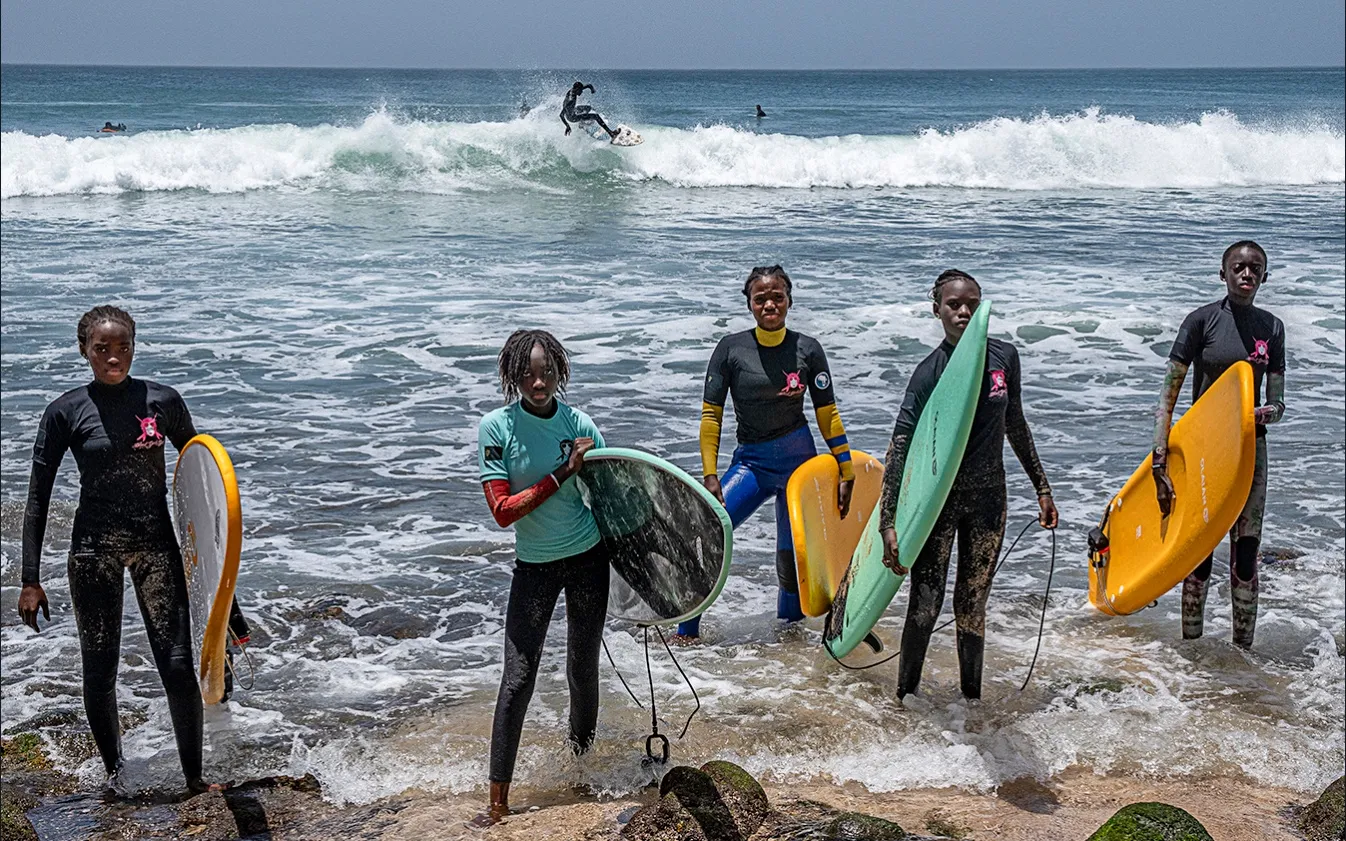
Girls from Black Girls Surf Academy posing for a photo with their boards after an intense surf session in Ngor Beach, Dakar on March, 31, 2026. Photo: Marta Moreiras, bird story agency
Khadija Sambe was 13 when she first stood up on a surfboard, an experience that would set her on a path few women in Senegal had ever taken.
The water off Ngor is moving in slow, regular sets as if it is breathing, folding and unfolding under a pale Atlantic sky. Light scatters across its surface, breaking into shifting patterns that blur the line between wave and horizon.
A small group of girls is already out beyond the shore break, boards angled beneath them as they wait for the next set. They drift in place, adjusting their balance with the tide, watching the sea gather itself into form before releasing it again.
When a wave rises, it does so without warning— pitching up fast, pulling the ocean into motion. One girl commits, paddling hard before pushing up to her feet in a movement that is still uncertain but increasingly familiar. The wave carries her forward as the others follow her line with their eyes.
On the sand, Khadija Sambe watches closely.
Ngor is a small fishing and surfing community on the western edge of Dakar, Senegal’s capital, where the city meets the Atlantic Ocean. It is a place shaped by the sea in every sense—where fishing boats are launched through the surf at dawn, where waves dictate movement and livelihood, and where surfing has long been part of youth culture.
Yet even amongst the youth, surf culture has historically belonged almost entirely to boys and men, leaving girls at the margins of the water they grew up beside. No longer.
Before her work in the academy, before she became a professional surfer and mentor, Sambe was a child in this same coastline, trying to understand her place in a sport that seemed to exclude her before she had even entered it.
The first time Khadjou Sambe stood up on a surfboard, she was 13.
“I screamed with joy,” she recalled. “It was something extraordinary.”
That moment, she explained, marked the beginning of a journey that would take her far beyond Ngor, but also deeper into the questions she had already begun to ask as a teenager: why did she not see girls in the water? And, why had she never seen a Black Senegalese woman surfer.
“I had never seen a black woman surfing before,” she said. “I kept asking myself: where are the girls? Where are the Senegalese?”
Those questions stayed with her. Surfing existed all around her, but always as something performed by others.
At home, that absence was reinforced by expectation. What she chose to do with the ocean was not seen as appropriate for a girl.