
Opinion
OPINIONS & PERSPECTIVES:Who will discipline Minister Pemmy Majodina?
By Mayibuye Melisizwe Mandela
13 September 2026 · 5 min read
South Africa cannot continue to build a culture of accountability in which an apology becomes the beginning and the end of every controversy involving a person in public office.
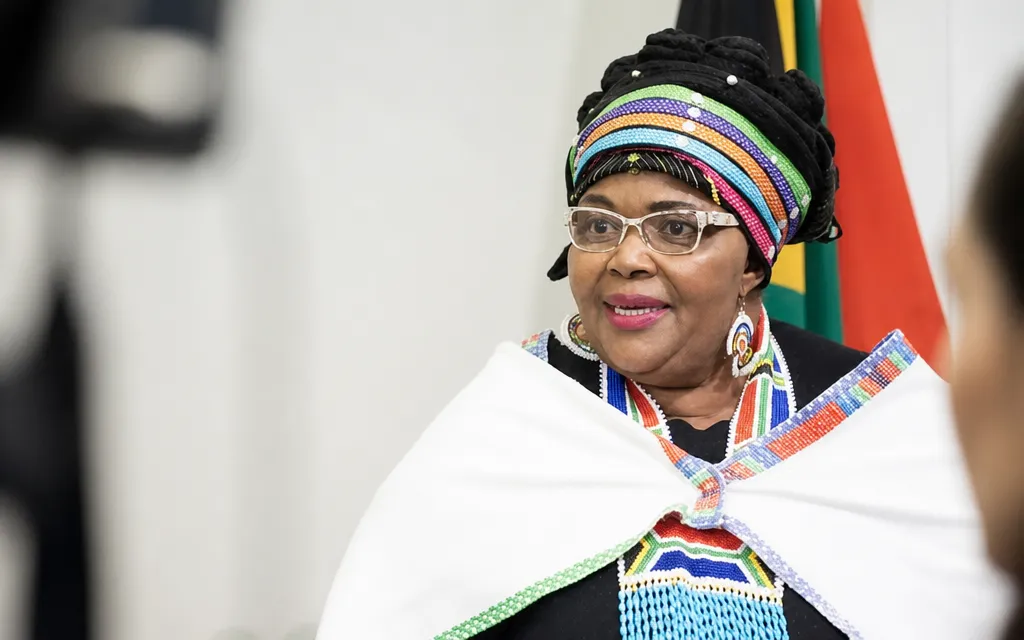
The recent conduct of Pemmy Majodina, a senior leader in the ANC and Minister of Water and Sanitation, raises a much bigger question than whether she has apologized or whether she will issue another statement. The controversy surrounding Minister Pemmy Majodina stems from a video of a community engagement in Loerie, a small farming town in the Kouga Local Municipality in the Eastern Cape, where a resident was being escorted from the venue following an altercation.
In the footage, the resident can be heard directing an insult at the Minister. Majodina then responds, on camera, by saying, “Phuma! Jou ma se po....s ook,” which translates roughly to, “Get out! Your mother’s private parts too” The video, which has subsequently been circulated widely, has attracted public criticism over the language used by a sitting Cabinet Minister towards a member of the public.
It is this conduct that has prompted me to ask the question: who holds a Minister accountable when she crosses the line? Majodina is not only a Cabinet Minister, but also an ANC member and a Member of Parliament.
The issue is therefore not simply about an argument between two individuals. It is about the standards expected from someone entrusted with public office and whether the appropriate political and institutional structures are prepared to act when those standards are breached.Majodina stems from a community engagement in Loerie, Kouga, where a resident was being escorted from the venue following an altercation. As the resident directed an insult at the Minister, Majodina responded on camera by saying, “Phuma! Jou ma se poes ook,” which translates roughly to, “Get out! Your mother’s private parts too.” The video subsequently circulated widely, attracting public criticism over the language used by a sitting Cabinet Minister towards a member of the public.
It is this conduct that prompted the question at the heart of this opinion piece: who holds a Minister accountable when she crosses the line? Majodina is not only a Cabinet Minister, but also an ANC member and a Member of Parliament. The issue is therefore not simply about an argument between two individuals. It is about the standards expected from someone entrusted with public office and whether the appropriate political and institutional structures are prepared to act when those standards are breached.
The question is simple: Who will hold her accountable?
Majodina is not merely an ANC member. She is a senior member of the organisation, a Member of Parliament and a Cabinet Minister. Each of those positions carries its own responsibilities and accountability mechanisms.
That means this matter cannot simply be buried beneath another apology.
The ANC Secretary-General, Fikile Mbalula, must answer whether the organisation will examine the conduct of one of its senior members in accordance with its disciplinary processes. Parliament must answer whether the relevant parliamentary ethics and accountability mechanisms will examine the conduct of a serving Member of Parliament. The Executive must answer whether the President, as Head of the National Executive, will seek an explanation from a Cabinet Minister whose conduct has raised serious public concern.
And Majodina herself must confront the most important question of all: Is this the standard of conduct that South Africans should expect from someone entrusted with public power? This is not an argument that public representatives must be protected from criticism or difficult encounters with citizens. Ministers and politicians are entitled to defend themselves and to challenge people when they believe they have been treated unfairly.
But there are boundaries.
Public power comes with a greater responsibility to exercise restraint, dignity and respect, particularly when dealing with ordinary citizens.
If the conduct captured or alleged in the available material is accurately represented, it deserves serious scrutiny. The fact that the person involved is reportedly living with a disability makes the matter even more sensitive and reinforces the need for the appropriate institutions to establish the facts and determine whether any rules or ethical standards were breached.
We must be careful, however, not to create a political culture where accountability depends on which faction, party or individual is involved.
The same standard must apply to everyone.
We have seen political leaders apologize after conduct that caused public outrage. We have accepted apologies because forgiveness is important in a democratic society. I previously made the same point in relation to Dada Morero. He apologised, and we forgave him. But forgiveness does not mean forgetting.
I sincerely hope that, following that apology, he also took the additional step of personally approaching the affected family and apologising to them. That is what meaningful accountability should look like.
But an apology cannot become a political escape route. While an apology may be part of accountability, it cannot automatically replace accountability. That is why Mbalula must not simply tell South Africans that Minister Majodina has apologized and that the matter is therefore closed.
The public deserves to know:
- Who will investigate?
- Who will determine whether disciplinary action is necessary?
- Who will hold her accountable as an ANC member?
- Who will hold her accountable as a Member of Parliament?
- Who will hold her accountable as a Cabinet Minister?
These are not unreasonable questions. They are precisely the questions that should be asked in a constitutional democracy where public representatives exercise power on behalf of the people.
If the President needs to intervene because the Minister serves in his Cabinet, then that responsibility must be exercised. If Parliament's mechanisms are applicable, they must be activated. If the ANC's disciplinary structures have jurisdiction over the conduct of its member, they must do their work.
This should not be about political humiliation or vengeance. It should be about standards. South Africa cannot demand accountability from ordinary citizens while creating the impression that political office provides protection from consequences.
The people who occupy positions of power must understand that their offices do not belong to them personally. They are temporary custodians of public authority. A Cabinet Minister is not above accountability. A Member of Parliament is not above accountability. An ANC member is not above the organisation's own disciplinary standards.
And no apology, however sincere, should prevent the appropriate institutions from establishing what happened and determining whether further action is required. The ANC has repeatedly spoken about discipline, organisational renewal and restoring public confidence. This is an opportunity to demonstrate whether those principles apply equally when the person facing scrutiny is a senior political figure.
No selective discipline. No political protection. No apology-and-forget politics.
Let the facts be established. Let the appropriate institutions do their work. Let the same standard of accountability apply to everyone. South Africans deserve public representatives who understand that power is a responsibility, not a licence to demean the people they are entrusted to serve.
The question therefore remains: Who will discipline Minister Majodina?
You may also like
Malema Returns To KuGompo City To Rally EFF Support Ahead Of Local Polls
Asemahle Mfombi · 20 Oct · 1 min read
OPINIONS & PERSPECTIVES: What If Science And Our Ancestors Are Speaking Of The Same Mystery?
 Sizwe Kupelo · 10 Oct · 3 min read

OPINIONS & PERSPECTIVES: Has The Eastern Cape Become Too Accustomed To Municipal Failure?
Andile Nduna · 10 Oct · 9 min read